- Data
- Insights
- Competitive Advantage
Information Is An Asset
Treating information as an asset drives innovation and business success
Information is an asset. It does accrete value through a value chain. Large organisations that do not have a culture of treating information as an asset – to be protected by a system of governance and enabled by a system of managing the information assets – are likely to befall a catastrophic change as their competitors or new entrants make use of the information they ignored. It is, however, much more than a big data technological solution. It is about embedding a mindset in current staff and recruiting and rewarding people who protect and leverage information assets as willingly and with as much insight as those that do so with physical and financial assets.
It is also about small to medium-sized organisations using the information they get to carve out niches which they can dominate through innovation in the goods and services they provide, to specific segments with specific needs.
Ignoring, under-utilising and refusing to continuously improve our capability to capture, analyse, interpret and share information is a pointer in today’s economy, of future decline.
The Information Value Chain
Treating information as an asset involves recognizing its value chain. This process transforms raw data into actionable insights, increasing its value at each stage. Organizations that embrace this concept implement a governance framework to manage and continuously improve their information assets.

Four Scenarios of Information Management
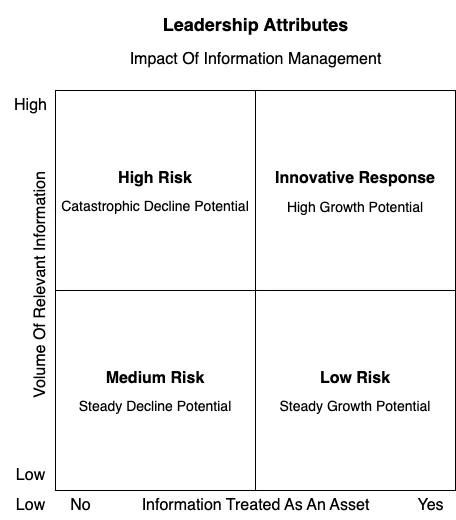
Information as an Asset with High Volume
Organizations in this category are dynamic and innovative. They integrate information-driven practices into their daily operations, strategy, and planning. These companies are well-positioned to benefit from big data initiatives.
Information as an Asset with Low Volume
These typically smaller organizations achieve steady growth despite limited resources. They excel at interpreting market signals and use every piece of information to guide their investments and innovations.
High Volume but Not Treated as an Asset
These companies are like “a person with severe myopia working in an optometrist shop, but never having had the sense to get a pair of prescription glasses.” Despite initial success, they risk catastrophic decline as competitors exploit insights they’ve missed. Examples include Kodak and Lehman Brothers.
Low Volume and Not Treated as an Asset
Often privately held medium-sized businesses, these organizations face a steady decline. They react rather than progress, relying on relationships rather than insights to navigate changing markets.
The Risks of Ignoring Information
Organizations that fail to treat information as an asset risk becoming obsolete. Large companies may face sudden, catastrophic changes as competitors or new entrants capitalize on ignored information. Smaller organizations may experience a slower decline but ultimately fade from view.
Embracing information as an asset is crucial for long-term success. It’s not just about implementing big data solutions; it’s about fostering a mindset that values information as much as physical and financial assets. For smaller organizations, it means using available information to carve out dominant niches through innovation. The difference between stagnation and growth often lies in how we value and utilize the information at our fingertips. In today’s economy, ignoring or underutilizing information is a clear indicator of future decline.
Written by

Mithun Sridharan
Founder, LinkPress
Mithun is a strategist, advisor, educator, and speaker focused on helping leaders make better decisions in environments shaped by change, complexity, and emerging technology. His work brings together leadership, management consulting, digital transformation, and artificial intelligence in a way that is practical, grounded, and commercially relevant.
Related Posts
How to find your unfair advantage?
Identify and leverage your unique strengths to create an unmatched position in your field
Mithun Sridharan- Insights
- Competition
- Competitive Advantage
- Corporate Strategy
- Business Strategy
Sources To Learn More About AI
Find sources that are not only comprehensive, but also regularly updated
Mithun Sridharan- Digital
- Data
- Insights
AI Algorithms And Bias
AI systems and algorithms should be free of bias and adhere to ethical standards
Mithun Sridharan- Data
- Insights
- Digital
- Literacy