- Decision-Making
- Leadership
- Mental Models
Vroom-Yetton-Jago Decision Model
The essence of effective leadership lies not just in making the right choice, but in carefully choosing the right people and procedure to arrive at that choice.
The genesis of this significant decision-making framework is deeply rooted in industrial and organizational psychology, particularly the study of managerial behavior. The initial formulation was introduced in 1973 by Victor Vroom, a distinguished professor at the Yale School of Management, and his colleague Phillip Yetton. They published their breakthrough concepts in the seminal work, leadership and Decision-Making. At its core, their initial work directly challenged the prevailing belief of the time, which suggested that a single, universally effective leadership style could be applied across all business scenarios. Instead, Vroom and Yetton passionately advocated for a contingency or situational viewpoint. They posited that the most effective managerial approach is entirely dependent upon the specific task at hand, the environment in which the decision must be made, and the unique dynamics of the team involved in the immediate moment.
Their initial creation, termed the Vroom-Yetton Model, functioned essentially as a prescriptive flow chart — a sophisticated decision tree designed to channel a leader’s thinking toward one of several possible decision-making processes. The model centered its focus on two main managerial objectives: ensuring the highest possible quality of the technical decision and securing the necessary commitment from team members for successful implementation. This early design was revolutionary because it introduced a structured, nearly mathematical, framework to address what was previously considered an intuitive human quality: sound judgment. It marked a transition from personality-based leadership theories to process-based organizational science. The leader was now responsible not only for the content of the decision but also for the rigor of the decision-making protocol itself.
Roughly fifteen years later, in 1988, the existing framework underwent substantial refinement and significant expansion through the integration of contributions from Arthur Jago. This collaboration resulted in the comprehensive and robust system recognized today as the Vroom-Yetton-Jago (V-Y-J) Normative Decision Model. Jago’s crucial additions enhanced the model’s overall precision by introducing several new situational variables and meticulously adjusting the weight given to various criteria within the decision-making flow. This major revision provided a far more detailed and nuanced set of rules, specifically addressing factors like pressing time constraints and the elevated potential for internal team conflict. Consequently, the updated model proved to be more durable and directly applicable to a much wider spectrum of complex, real-world organizational challenges. Vroom, Yetton, and Jago collectively refined the “algorithm” of effective leadership. They successfully converted what was previously seen as an act of intuition and personal preference into a methodical, step-by-step diagnostic tool that any capable manager could employ. This model remains a lasting tribute to their commitment to understanding how organizational leaders can expertly balance the immediate need for efficiency and rational outcomes with the equally essential requirement for strong employee participation and widespread acceptance.
The Framework
The Vroom-Yetton-Jago (V-Y-J) framework serves as a sophisticated, integrated navigational system, deliberately guiding leaders away from automatic or reactive behaviors. It encourages them toward a calculated selection of the most fitting decision-making procedure. The model’s effectiveness stems from its compulsory structure, which requires the leader to meticulously diagnose the current situation first, treating the decision requirement as a unique problem that demands a tailored, specific solution. The complete framework is systematically organized around three primary situational dimensions, which then feed into a sequence of seven diagnostic questions. Answering these questions truthfully funnels the circumstances toward one of five prescribed procedural options.
The Foundational Contextual Variables
Prior to engaging with the formal decision-making flow chart, the leader must conduct a rapid but rigorous initial evaluation. This focuses on three critical, overarching dimensions that establish the fundamental context for the entire process. These variables are the non-negotiable bedrock upon which all subsequent analysis rests:
- Decision Quality (QD)
- Subordinate Commitment (CR)
- Time Constraints (TC)
Decision Quality (QD)
This variable gauges the overall importance of the technical or rational aspects of the final outcome. A high Decision Quality Requirement means the absolute correctness of the choice is paramount. This typically occurs because a failure or suboptimal choice would incur significant negative impacts, such as severe financial losses, major operational disruptions, or serious legal liabilities. In scenarios demanding high quality, the leader must guarantee that all relevant expertise, specialized data, and organizational knowledge are effectively utilized. Conversely, if the quality necessity is low — for example, choosing between two equally viable software vendors or the layout of an internal email — the leader can safely opt for a rapid, solitary judgment, thereby conserving valuable corporate time and resources. The total investment of organizational resources — in terms of effort, time, and human capital — should directly correspond to the established significance of the quality requirement.
Subordinate Commitment (CR)
This variable assesses the degree to which the successful execution and subsequent implementation of the decision depend entirely upon the team members’ voluntary agreement and deep engagement. Even the most technically brilliant decision can become utterly ineffective if the individuals responsible for carrying it out passively resist or actively sabotage the outcome. When a decision will profoundly affect the team’s day-to-day workflow, shift their existing job roles, or alter their immediate working environment, securing their Commitment Requirement rises in importance to match that of the decision’s quality. Involvement naturally fosters ownership. Therefore, the V-Y-J model systematically favors decision procedures that are more collaborative when the team’s buy-in is absolutely essential to prevent later behavioral issues like apathy, passive resistance, or outright deliberate non-compliance during the execution phase.
Time Constraints (TC)
Time represents the ultimate limiting resource, and the urgency or immediacy of the problem frequently determines the practical feasibility of involving numerous others. This dimension directly asks whether the luxury of extensive consultation, detailed discussion, or full, democratic collaboration is realistically available. A decision that is time-critical — often called a “crisis point” or “burning bridge” scenario — automatically restricts the leader’s available procedural options, naturally pushing the required process toward more independent, rapid, or autocratic styles. However, when the schedule permits a reasonable window for input, the model strongly encourages more inclusive methods. It operates on the principle that involving the relevant team, while potentially slower in the initial diagnostic phase, generally yields decisions with significantly stronger execution, better long-term resilience, and greater overall organizational health.
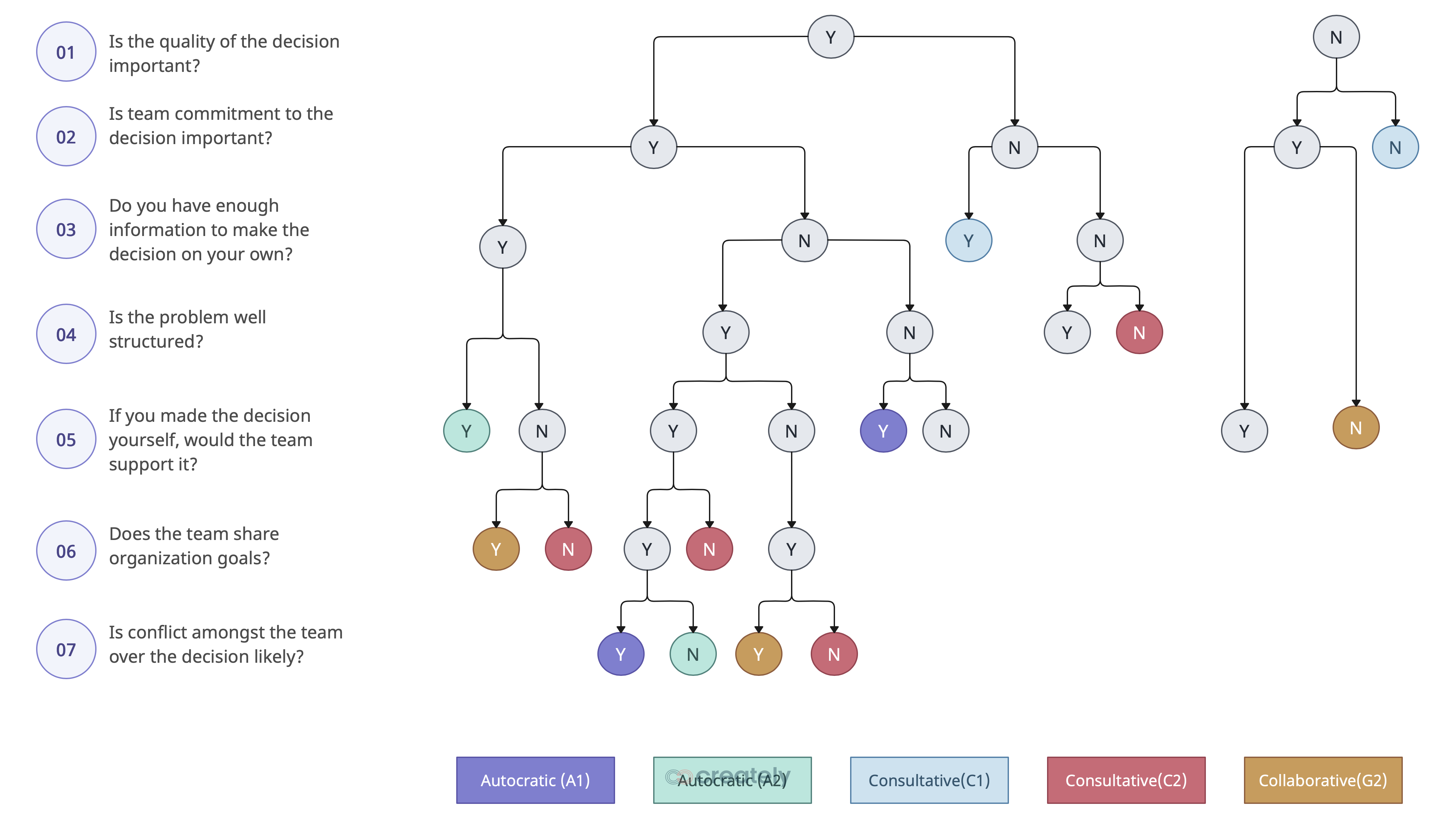
Seven Diagnostic Questions
Once the initial three contextual dimensions are clearly assessed, the leader proceeds to use a sequential set of seven Binary (Yes/No) questions. These questions function like checkpoints or logical gates on the decision pathway, systematically excluding inappropriate styles. By answering each question with complete honesty, the leader is logically funneled toward the single most appropriate procedural option. The questions are:
Problem Diagnosis And Information Needs
- Was the quality of the decision very important (significant consequences of failure)?
- Did a successful outcome depend on others being committed to the decision (buy-in needed for the solution to work)?
- Was enough information available to make the decision solo (no need to consult others)?
Commitment and Acceptance Analysis
- Was the problem well-structured with an obvious way to decide the best course of action (clear problem/solution and criteria for a successful outcome)?
- Was it likely that a solo decision (without consulting others) would be well received and accepted?
- Were the goals of those impacted by the decision consistent with the goals of the leader (everyone wants the same outcome)?
Conflict and Consensus
- Was there a conflict about which solution was best?
Problem Diagnosis And Information Needs
Quality Requirement (QR)
Does the problem have a quality requirement such that one potential solution is demonstrably superior to another?
This question is the starting point. If the answer is ‘No’, it means that all potential outcomes are essentially equally acceptable, and the decision process can be immediately simplified, as selecting a suboptimal choice will not incur significant organizational harm. If the answer is ‘Yes’, the leader must proceed to the next question, signaling the absolute necessity for careful and rigorous consideration.
Leader’s Information (LI)
Does the leader possess sufficient information, data, or expertise to make a high-quality decision independently?
This crucial question serves as a personal reality check for the leader. The leader must execute an honest audit of their current, available knowledge base. If they acknowledge a deficiency in the necessary data, specialized expertise, or relevant context, they are then mandated to involve others to successfully fulfill the Quality Requirement (QR). This necessity immediately channels the suggested style away from Autocratic I (AI) and toward styles involving greater consultation, such as Autocratic II (AII) or Consultative styles (CI/CII).
Problem Structure (ST)
Is the specific problem currently well-structured?
A well-structured problem is defined by having clearly delineated objectives, variables that are generally known, and an established, defined process for both generating and rigorously evaluating potential solutions (e.g., how to maximize production volume while strictly adhering to fixed operating costs). Conversely, an unstructured problem — such as defining the company’s new core ethical vision or entering an entirely new and ambiguous market — inherently requires divergent thinking and creative ideation. In this scenario, drawing on diverse group input is practically indispensable for generating high-quality alternatives.
Commitment and Acceptance Analysis
Commitment Requirement (CR)
Is voluntary team commitment absolutely essential for the successful execution of this decision?
This represents a high-stakes turning point in the diagnostic process. If the team’s willingness, enthusiasm, or heart is not invested in the final decision, its execution success is profoundly jeopardized. If securing this commitment is determined to be essential, the process must inevitably trend toward more collaborative or participatory styles, specifically Consultative II (CII) or Group II (GII), where engagement is maximized.
Commitment Probability (CP)
If the leader were to make the decision alone (autocratically), is it reasonably certain that the subordinates would still fully accept and actively commit to the outcome?
This is the secondary, more refined test for commitment. It helps the leader identify those specific situations where the team either implicitly trusts the leader’s judgment regardless of the process, or views the final decision as peripheral or inconsequential to their immediate work responsibilities. If the leader’s solo decision is highly probable to be accepted without resistance, a time-consuming consultative style becomes unnecessary, thereby saving valuable organizational momentum.
Goal Congruence (GC)
Do subordinates collectively share the broader organizational goals that the decision seeks to achieve?
If the team’s immediate objectives are perfectly aligned with the larger organizational mission, the leader can place a high degree of trust in their unfiltered input and participation. However, if the goals are incongruent — for example, if the team prioritizes personal scheduling comfort over the organization’s need for peak-hour customer coverage — the leader must exercise a much greater degree of control during the process to safeguard the overall strategic outcome. Such misalignment forces the recommended procedure to revert back toward tightly controlled Autocratic (AII) or highly constrained Consultative (CI) styles.
Conflict And Consensus
Subordinate Conflict (CO)
Is internal disagreement or conflict among subordinates a likely outcome over the preferred solution?
The high potential for interpersonal friction or functional conflict (e.g., between the sales team and the product development team) is a major external variable. If significant disagreement or an internal deadlock is anticipated, the leader is ethically bound to intervene and actively manage the process. In such a case, the model suggests one of two distinct paths: either moving toward full group collaboration (GII), where the leader acts as a neutral facilitator of consensus, or conversely, pulling the decision back to a controlled Consultative (CII) or even Autocratic (AII) style to prevent the conflict from completely derailing the organizational outcome. The final specific path depends entirely on the logical sequence of answers to the preceding six questions.
The Five Decision Procedures
The methodical sequence of answers to the seven diagnostic questions naturally guides the leader directly to one of five established decision procedures. These procedures collectively represent a clear spectrum of increasing team involvement and shared decision authority.
Autocratic Procedures
Leader Makes the Final Decision Alone
Autocratic I (AI)
The leader utilizes only the information and knowledge they already possess within their personal reservoir to make the decision instantly. There is absolutely no formal consultation or discussion initiated with the subordinates. This style is the fastest and most independent option. The leader functions as the solo lighthouse keeper, setting the organizational course based entirely on the pre-existing navigational charts in their immediate view. This style is optimal for low-stakes situations, highly time-critical problems, or purely technical decisions where the leader is the undisputed subject-matter expert.
Autocratic leadership styles are common among many famous entrepreneurs. Steve Jobs was often regarded as an authoritarian leader. Some would even argue that he was more of a dictator than a leader. Jobs was accused of not being a team player and was deemed very demanding in terms of extracting outputs from his team. He was seen as someone who liked to have authority over the creative aspects of his products. He believed that people don’t want what they need until they are shown what they require. This is a typical A1-style mindset, which for him was quite successful owing to his creative genius. However, this didn’t make him a very likable individual among his peers.
Autocratic II (AII)
The leader systematically gathers necessary data, facts, or raw information from various subordinates individually. Crucially, the subordinates do not offer specific solution suggestions, nor do they collectively participate in the final evaluation of the available alternatives. The leader alone synthesizes the information and then renders the final, non-negotiable decision.
The leader assumes the role of the forensic data analyst, methodically collecting isolated pieces of evidence (information) from various organizational witnesses before executing the final, definitive judgment in complete isolation.
Bill Gates is often attributed to being an autocratic leader, although he is considered to apply more than one style of decision-making. Much of Gates’ success is often attributed to quick and timely decision-making, which requires some form of authoritarian style. He was so authoritarian that he even signed the expenses for his second in command, Steve Ballmer, who later became CEO of Microsoft. Bill Gates was famous for collecting information from his team and questioning their facts during meetings. His authoritarian style meant that he would question and interrupt their assumptions frequently during a meeting. This is a typical example of A2 since the leader gathers information, strictly analyzes it, and proceeds to decide.
Consultative Procedures
Leader Seeks Input, Leader Retains Veto Power
Consultative I (CI)
The leader shares the problem’s details with relevant subordinates, speaking to each person individually to acquire their unique ideas and specific suggestions. The definitive final decision is still made solely by the leader, who may or may not consciously reflect the subordinates’ suggestions in the final output. The team members are explicitly not brought together as a single group for discussion.
The leader acts as the private counselor, holding confidential, one-on-one briefings with individual specialized experts to inform a ruling that they must ultimately issue and own entirely themselves.
C1 is a softer form of authoritarian leadership style. Perhaps a good example of C1 is Jim Lentz, chief executive officer of Toyota Motor North America, Inc, a hands-on leader who works with his team’s challenges and failures.
Consultative II (CII)
The leader shares the problem publicly with the subordinates as an entire group, actively soliciting their collective ideas, brainstorming suggestions, and initial impressions during a formal meeting or discussion. The final decision, however, is still formally made by the leader, who remains free to use or disregard the collective group’s input as they see fit.
The leader serves as the supreme court judge, hearing all arguments and evidence presented from all relevant organizational sides in an open, collective session before retreating to their chamber to deliver the definitive, final, and binding ruling.
The founder of Mary Kay Cosmetics, Mary Kay Ash, was known to put in extra effort to cater to her employees’ needs. She was famous for having a confident workforce, which was rewarded periodically with gifts and perks. She made an effort to keep her employees individually happy and was deemed a C2 style leader.
Collaborative Procedure
Group Holds the Final Decision Power
Group II (GII)
The leader shares the problem completely with the entire team, and their primary role shifts entirely to acting as a neutral facilitator who expertly helps the group work toward a consensus-based solution. The leader deliberately refrains from attempting to influence the group toward adopting their own personal or preferred solution. They are committed to accepting the final solution that the entire group agrees upon.
The leader becomes the symphony orchestra conductor, skillfully ensuring that all sections play in perfect harmony, but the actual musical composition (the final decision) is conceptually co-created, mutually owned, and unanimously played by the entire ensemble. This procedure stands as the only one where the power of the final decision authority rests entirely with the group, not the individual leader.
Walt Disney, the founder of one of the world’s most profitable entertainment companies in his early days as an entrepreneur, has a collaborative leadership style. While in later years, he adopted various leadership styles, in the formative years of the Disney empire, he used a G2 style. This was also needed in those days as many people required to collaborate together when creating animated stories. Such a successful collaboration could not have been possible without the support of a leader to give his subordinates creative freedom in a collaborative environment.
Unique Content And Deeper Insights
While the V-Y-J model is often presented as a rigid set of rules, its true value lies in its power as a cognitive lubricant, forcing the leader out of instinctive, habitual biases. A leader who habitually uses Autocratic I (AI) may struggle to trust their team, leading to a breakdown in commitment (CR). Conversely, a leader who always defaults to Group II (GII) wastes valuable time and resources on trivial decisions where commitment is not a factor (low CR, low QR). The model serves as a calibration tool, ensuring that the process cost — in time, emotion, and complexity — never exceeds the benefit derived from the decision outcome.
The distinction between Consultative II (CII) and Group II (GII) is often poorly understood but represents a fundamental shift in control. CII is about maximizing input quality while retaining ultimate accountability. The leader still acts as the ultimate filter and safety valve. GII is about maximizing commitment (CR) and developmental opportunity. In GII, the leader temporarily relinquishes the veto power, accepting the potential risk of a technically imperfect decision in exchange for the guaranteed, deep-seated ownership and rapid, enthusiastic execution that consensus brings. A leader must have absolute trust in the group’s goal congruence (GC) before selecting GII. If goal congruence is even slightly suspect, the leader must revert to the control mechanism of CII.
Case Study: IBM
Strategic Renewal and Organizational Structure at IBM
In the late 1990s and early 2000s, International Business Machines (IBM) was undergoing a massive, multi-faceted transformation from a product-centric hardware giant to a services-led, globally integrated technology and consulting company. A key strategic decision needed to be made regarding the redesign of the company’s internal structure and reporting lines to support the new focus on services. This decision was led by Samuel J. Palmisano, who would later become the Chief Executive Officer (CEO). The challenge was monumental: how to shift thousands of employees and complex reporting structures without disrupting ongoing client services.
Applying The V-Y-J Model To IBM’s Strategic Reorganization
The problem — re-architecting a global, multi-billion dollar organizational structure — had profound implications. A poorly designed structure would cripple the new services strategy.
- Quality Requirement (QR): Yes. The technical quality of the new structure (which groups, what reporting lines, how resources are allocated) was mission-critical. Failure meant market irrelevance
- Leader’s Information (LI): No. No single executive, not even the future CEO, possessed sufficient, localized knowledge about every global business unit, legal restriction, or cultural requirement to design the entire system alone
- Problem Structure (ST): No. The problem was highly unstructured; it required creating a new, unprecedented structure (the “Globally Integrated Enterprise”) for a company of IBM’s scale, demanding creative thought and novel solutions beyond standard organizational charts
- Commitment Requirement (CR): Yes. Implementation depended entirely on thousands of senior and middle managers accepting the radical changes to their authority, budgets, and teams. Passive resistance would kill the project
- Commitment Probability (CP): No. Given the scope of change, a solo decision announced from the top would have been met with immediate skepticism, political maneuvering, and widespread turf wars
- Goal Congruence (GC): Yes. While individual goals (e.g., maintaining team size) might conflict, the core leadership team and vast majority of managers shared the macro goal of ensuring IBM’s long-term survival and success
- Subordinate Conflict (CO): Yes. Significant conflict was guaranteed, primarily along functional and geographic lines (e.g., “The US structure should dominate,” or “Consulting needs to be separate from Software”). This was unavoidable political reality
The diagnostic pathway clearly pointed toward the highest level of involvement, bypassing Autocratic (AI, AII) and simple Consultative (CI) styles. The presence of high QR, high CR, and high CO, combined with low LI and low ST, dictated a move toward Consultative II (CII) and ultimately, Group II (GII) for localized implementation.
IBM’s Execution Strategy
Palmisano deliberately chose a CII approach at the executive level. He shared the problem not just with the Executive Committee, but also with a diverse, cross-functional group of approximately 50 top managers, known internally as the Growth & Transformation Team. They met as a group to generate and debate structural alternatives (CII). Palmisano acted as the ultimate decision-maker, synthesizing the collective input into a coherent strategic blueprint. This step ensured the highest quality decision informed by global expertise.
Following this, the blueprint was devolved down into regional and functional “War Rooms” across the globe. These localized teams were given the strategic objective (the ‘What’) and were then empowered to make the tactical decisions about implementation (the ‘How’) using a Group II (GII) consensus style. For instance, the European team was tasked with achieving consensus on how to merge disparate country-specific sales teams into a single pan-European services structure. Palmisano’s directive to these local teams was:
You have the core goals. Now, you must agree as a group on the operating model that best achieves it
He removed his direct influence, facilitating a local consensus.
By strategically shifting from a high-level CII process (to design the core structure) to a decentralized GII process (to manage local structural implementation and conflict), IBM secured the necessary local commitment and diffused the political conflict. This layered, V-Y-J informed process was central to the successful execution of the organizational transformation, allowing IBM to effectively align its operational structure with its new, highly successful market strategy, which fundamentally relied on global integration and employee buy-in.
Written by

Mithun Sridharan
Founder, LinkPress
Mithun is a strategist, advisor, educator, and speaker focused on helping leaders make better decisions in environments shaped by change, complexity, and emerging technology. His work brings together leadership, management consulting, digital transformation, and artificial intelligence in a way that is practical, grounded, and commercially relevant.
Related Posts
Recognition-Primed Decision (RPD) Model
When moments demand immediate action, expertise guides the way to a timely solution
Mithun Sridharan- Leadership
- Decision-Making
- Mental Models
- Psychology
Community
What Makes Someone a Leader
Leadership psychology and studies on being a Leader
Mithun Sridharan- Leadership
- Psychology
- Mental Models
Consultant vs Coach
Intervention models differ by focusing on external answers or internal growth
Mithun Sridharan- Leadership
- Decision-Making
- Strategic Management
- Change