- Models
- Insights
- Concepts
- Change Management
Swiss Cheese Model
Swiss Cheese Model illustrates how accidents occur when weaknesses in multiple system defenses align, allowing hazards to pass through

At its core, the Swiss Cheese Model depicts an organization’s defenses against failure as a series of barriers, represented by slices of Swiss cheese. Each slice represents a defensive layer in the system, such as procedures, training, or equipment. The holes in the cheese represent weaknesses or vulnerabilities in these defenses. When these holes momentarily align across all slices, a hazard can pass through, potentially resulting in an accident or failure.
The genius of this model lies in its simplicity and its ability to explain complex system failures. It emphasizes that accidents are not typically the result of a single catastrophic error, but rather the unfortunate alignment of multiple smaller failures or weaknesses. This perspective shifts the focus from blaming individuals to understanding and improving the system as a whole.
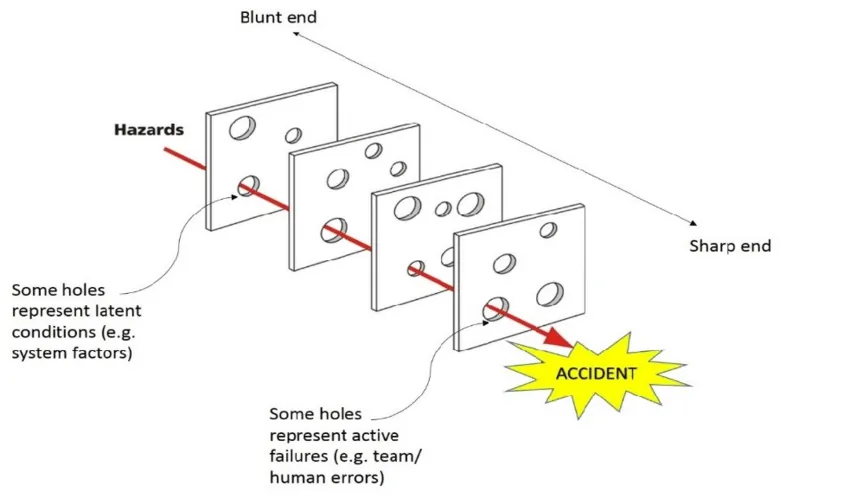
In the Swiss Cheese Model, there are two types of failures that contribute to the holes in the cheese: active failures and latent conditions. Active failures are unsafe acts committed by people who are in direct contact with the system. These can include errors, violations of procedures, or mistakes. Latent conditions, on the other hand, are the less obvious systemic weaknesses that may lie dormant in the system for years before they combine with active failures and local triggers to create an accident opportunity.
The model suggests that by addressing both active failures and latent conditions, organizations can reduce the likelihood of accidents. This involves not only improving individual performance but also strengthening the system’s defenses at multiple levels.
Example
One of the key strengths of the Swiss Cheese Model is its applicability across various industries and scenarios. Let’s consider an example from healthcare to illustrate how this model works in practice:
Imagine a hospital where a patient is given the wrong medication, resulting in a severe allergic reaction. At first glance, it might seem that the nurse who administered the medication is solely responsible. However, applying the Swiss Cheese Model reveals a more complex picture:
- Prescribing: The doctor prescribed the medication without checking the patient’s allergy history (a hole in the first slice)
- Pharmacy: The hospital’s electronic system failed to flag the potential allergy due to a software glitch (a hole in the second slice)
- Nursing: The nurse, working a double shift due to staff shortages, failed to double-check the patient’s allergies before administering the medication (a hole in the third slice)
- Patient: The patient, feeling unwell and confused, didn’t mention their allergy when given the medication (a hole in the fourth slice)
In this scenario, the error passed through multiple layers of defense, each with its own weakness or “hole.” The accident occurred not because of a single massive failure, but because all these smaller failures aligned at the same moment, creating a clear path for the error to occur.
Points of failure
By analyzing this incident through the lens of the Swiss Cheese Model, the hospital can identify and address multiple points of failure:
- Improving the prescribing process to ensure allergy checks are always performed
- Upgrading and regularly testing the electronic alert system
- Addressing staffing issues and reinforcing the importance of safety checks, even during busy periods
- Enhancing patient education about the importance of communicating allergies.
This approach allows for a more comprehensive and effective response to the incident, reducing the likelihood of similar errors in the future.
The Swiss Cheese Model has profound implications for how we approach safety and risk management across various fields. It encourages a systemic view of accidents, moving away from a culture of blame to one of continuous improvement. By recognizing that errors are often the result of multiple factors aligning in unfortunate ways, organizations can develop more robust and multi-layered defense strategies.
Moreover, the model highlights the importance of maintaining and continuously improving all layers of defense. It’s not enough to have multiple safety measures in place; these measures must be regularly assessed, updated, and strengthened to minimize the “holes” in each layer.
Written by

Mithun Sridharan
Founder, LinkPress
Mithun is a strategist, advisor, educator, and speaker focused on helping leaders make better decisions in environments shaped by change, complexity, and emerging technology. His work brings together leadership, management consulting, digital transformation, and artificial intelligence in a way that is practical, grounded, and commercially relevant.
Related Posts
SCOR Model
Driving Operational Excellence through integrated Supply Chain frameworks
Mithun Sridharan- Concepts
- Models
- Methodologies
FAB Model
Translating technical capabilities into measurable customer outcomes
Mithun Sridharan- Models
- Communication
- Concepts
WOOP Coaching Model
A science-based strategy for goal achievement and change
Mithun Sridharan- Models
- Executive Coaching
- Insights