Research Methodology
A robust research methodology transforms raw data into credible, strategic intelligence
A lead consultant at a global firm recently faced a high-stakes dilemma. The client, a multi-billion dollar retail giant, demanded an immediate strategy to combat declining foot traffic. The consultant could have simply gathered existing sales reports and called it a day. However, she knew that merely collecting information is not true research. To provide a recommendation that the board would actually trust, she had to prove its truthfulness through a transparent, rigorous process.
She spent the first week not looking at data, but designing the “how” of the study. She treated the methodology as a lighthouse, guiding her team through the fog of contradictory market signals. By the time they presented, the board didn’t just see a solution; they saw the architectural integrity of the evidence. This transition from “gathering information” to “seeking answers to unanswered questions” is what separates a mere observer from a true strategic researcher. When you define your methodology, you are not just listing steps; you are building the foundation of your professional credibility. If the foundation is shaky, the entire strategic structure will eventually collapse under the weight of scrutiny.
Architecture of Inquiry
In professional consulting and academic circles, people frequently use “methods” and “methodology” as synonyms, yet they represent distinct layers of the research process. Understanding this distinction is vital for any executive or MBA [Master of Business Administration] student. Methods are the technical procedures, practical tools, or specific steps taken to generate and analyze data. They are the “what” of the operation—the surveys, interviews, or statistical models used to gather evidence.
Conversely, methodology is the underlying theory, analysis, and set of principles that inform how research proceeds. It is the “why” behind the “what”. Methodology encompasses the theories and values that support a specific approach, serving as the systematic method to resolve a research problem. While methods provide the tools, methodology provides the blueprint that ensures those tools are used correctly to produce valid results.
The Strategic Paradigms
Selecting a methodological approach is a consequential decision influenced by the researcher’s philosophical stance and the specific phenomenon under investigation. There are three primary paradigms utilized by research institutions today:
- Quantitative Research: Often aligned with the scientific paradigm, this approach seeks to quantify data and generalize findings from a sample to a target population. It utilizes structured collection processes and statistical analysis to provide objective insights
- Qualitative Research: This framework prioritizes contextualization and interpretation over prediction. It aims to create detailed descriptions of observations through subjective analysis, typically involving smaller, carefully selected groups of respondents
- Mixed Methods: A contemporary approach that fuses quantitative and qualitative elements to view complex social relations more clearly. This method utilizes triangulation to present multiple findings about a single phenomenon within one study
Research Onion Model
The Research Onion, popularized by Saunders, Lewis, and Thornhill, serves as the definitive framework for engineering a rigorous research methodology. It posits that a study’s technical procedures are only as strong as the philosophical and strategic layers that support them. By peeling back each layer, a researcher ensures that their final data collection is not a random act but a logical conclusion of their intellectual stance.
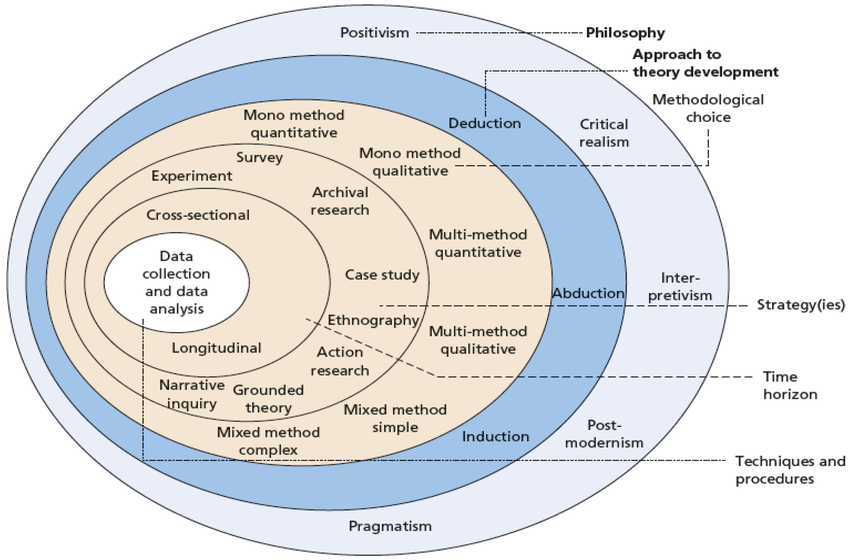
Layer 1: Research Philosophy
The outermost layer addresses the researcher’s assumptions about the nature of reality and knowledge. This choice colors every subsequent decision in the research process.
- Positivism: This philosophy assumes an objective reality that can be measured scientifically. It relies on observable facts and statistical regularities.
A retail executive uses positivism to determine if lowering prices by 10% consistently increases sales volume across 500 locations.
- Interpretivism: This approach suggests that reality is socially constructed and highly subjective. It seeks to understand the “why” behind human behavior through deep context.
A consultant uses interpretivism to explore how employee morale changed following a sudden merger, focusing on personal narratives and emotional responses.
Layer 2: Research Approach
This layer determines the relationship between the research and theory—whether the study starts with a theory or ends with one.
- Deductive: The researcher starts with a known theory, develops a hypothesis, and designs a study to test if that theory holds true in a specific case.
Testing the “Law of Demand” by observing if consumers buy fewer luxury goods during an interest rate hike.
- Inductive: The researcher collects data first and then looks for patterns to build a new theory or framework.
Interviewing ten successful “solopreneurs” to identify a new, unnamed commonality in their morning routines.
Layer 3: Research Strategy
The strategy is the general plan for how the researcher will answer their specific question. It acts as the tactical bridge between theory and data.
- Case Study: An intensive investigation of a single unit (a person, a company, or a project) to provide a localized, detailed account.
Analyzing the 2021 supply chain failure of a specific automotive manufacturer to identify point-of-failure triggers.
- Survey: A method used to gather standardized data from a large group to identify broad trends.
Sending a digital questionnaire to 2,000 remote workers to measure their average daily screen time.
Layer 4: Research Choice
This layer specifies the “methodological mix.” It determines if the researcher stays within one tradition or fuses multiple traditions to gain a clearer view of complex social relations.
- Mono-method: Using only one type of data collection, such as just interviews or just surveys.
- Mixed Methods: Combining quantitative and qualitative data to provide a more comprehensive answer.
Using a survey to find out how many customers are unhappy (Quantitative) and then conducting focus groups to find out exactly why they feel that way (Qualitative).
Layer 5: Time Horizon
The time horizon defines the “shutter speed” of the research—whether it is a snapshot or a film.
- Cross-sectional: Data is collected at one specific point in time to describe a current state.
A “Day in the Life” study of hospital staff productivity on a specific Monday in March.
- Longitudinal: Data is collected repeatedly over an extended period to track changes and developments.
Tracking the career progression of a specific group of MBA graduates every two years for a decade.
Layer 6: Techniques and Procedures
This is the central core where the actual “work” of data collection happens. It involves the specific instruments and analysis methods used.
- Data Collection: Using tools like semi-structured interviews, observation logs, or automated web scraping.
- Data Analysis: The process of making sense of the data, such as using regression analysis for numbers or thematic coding for text.
Using a “Thematic Coding Ledger” to categorize the common fears mentioned by startup founders during recorded interviews.
Methodological Alignment Matrix
This matrix demonstrates how to maintain vertical consistency. For a study to be valid, the choices in the inner layers must logically align with the philosophy chosen at the start.
| Layer | Design A (Scientific/Standardized) | Design B (Human-Centric/Narrative) |
|---|---|---|
| Philosophy | Positivism (Objective) | Interpretivism (Subjective) |
| Approach | Deductive (Testing theory) | Inductive (Building theory) |
| Strategy | Experiment | Ethnography (Immersion) |
| Choice | Quantitative | Qualitative |
| Horizon | Cross-sectional | Longitudinal |
| Techniques | Structured Questionnaires | Unstructured Interviews |
By utilizing this layered approach, researchers move beyond merely “gathering information” to creating a transparent, reproducible blueprint that stands up to professional and academic scrutiny.
Constructing the Methodology Section
Writing the methodology for a research paper or a strategic proposal is often overwhelming for novice researchers due to its intricate elements. To elevate career prospects and ensure reproducibility, a methodology must be thorough and straightforward.
The methodology section should introduce the specific approach—whether quantitative, qualitative, or mixed—and establish a clear connection to the research problem. It must describe the instruments used, such as questionnaires or observation logs, and provide background information on any archival data. Furthermore, a transparent discussion of the sampling process and an acknowledgment of practical limitations are essential to maintain the integrity of the findings.
Ethical Stewardship in Data Collection
Strategic research demands adherence to ethical norms to ensure accountability and mutual respect. Leadership must consider several factors:
- Rights to Privacy: Protecting the identity and personal space of individuals involved
- Voluntary Participation: Ensuring participants can withdraw from the process at any time
- Informed Consent: Obtaining explicit agreement from all participants before data collection begins
- Confidentiality and Anonymity: Maintaining the security of data and removing identifiable markers from participants
- Researcher Objectivity: Ensuring the behavior of the researcher does not bias the reported results
Case Study: Public Health and Public Discourse
Publicly traded organizations often rely on rigorous methodologies to validate their societal impact or product efficacy. In the public health sector, researchers conducted a massive quantitative study to analyze the relationship between physical activity and heart disease risk.
The methodology involved a structured survey distributed to 10,000 participants. By using logistic regression for data analysis, the researchers identified significant predictors with high statistical reliability. This objective approach allowed the findings to be generalized across adult populations, providing a credible foundation for public health policy and corporate wellness strategies alike. This case demonstrates that a large sample size and structured statistical methods are vital for establishing generalizable truths in a competitive marketplace.
Strategic Advantages and Disadvantages of Methodological Choices
| Approach | Strategic Advantage | Critical Disadvantage |
|---|---|---|
| Quantitative | Provides objective, generalizable data for large-scale decision making | May miss nuanced contextual information or “the human element” |
| Qualitative | Offers deep interpretation and rich, narrative insights into behavior | Smaller sample sizes limit the ability to generalize results |
| Mixed Methods | Enhances validity through triangulation of different data types | Requires significantly more time and resources to execute properly |
| Systematic Design | Bolsters credibility and reproducibility for peer recognition | Can be overwhelming for novice researchers to implement correctly |
| Ethical Rigor | Builds stakeholder trust and ensures long-term accountability | May limit the speed or scope of data gathering processes |
Strategic Executive Sampling Design
Precision in participant selection ensures the depth of strategic findings. A qualitative sampling plan for executive leadership styles prioritizes depth over breadth. By utilizing non-probability techniques, researchers can target specific “information-rich” cases that align with the philosophical underpinnings of the study. This systematic approach ensures that the resulting data provides the contextualization and interpretation necessary to address complex organizational problems.
Selecting participants for a study on executive leadership is akin to a venture capitalist vetting a startup; the quality of the individual outweighs the quantity of the data points. In qualitative research, the goal is not to generalize results to an entire population, but to provide a complete and detailed description of observed behaviors. Because the executive suite is often inaccessible and highly diverse, a “random” sample would likely fail to capture the specific nuances of high-stakes decision-making. Instead, the researcher must act as a curator, identifying individuals who embody the specific leadership paradigms—such as transformational, servant, or transactional—under investigation.
The integrity of this study depends on a clear sampling process. If the selection is haphazard, the foundation of the research becomes shaky, undermining the eventual strategy. By documenting the rationale behind each choice, the researcher maintains transparency and reproducibility. This proactive approach safeguards the findings and reinforces stakeholder confidence in the final report.
The Qualitative Sampling Framework
To investigate leadership styles effectively, the sampling plan must move beyond basic demographics and into strategic alignment. The following phases outline a rigorous approach to selecting executive participants.
- Define the Research Universe: Identify the specific industry or organizational size that fits the research question. For example, a study on “Agile Leadership” might focus exclusively on Chief Technology Officers (CTO) in the software sector
- Select the Sampling Strategy: Qualitative studies typically utilize purposive sampling, where participants are chosen based on their relevance to the research objectives
- Establish Inclusion Criteria: Define the required years of experience, direct-report count, and specific leadership milestones. This ensures the “background information” for each participant is consistent and relevant
- Address Potential Biases: Explicitly state how the selection process mitigates “convenience bias” or “gatekeeper influence” to ensure the validity of the findings
Primary Qualitative Sampling Techniques
| Technique | Strategic Application | Rationale |
|---|---|---|
| Criterion Sampling | Selecting executives who have led a successful IPO [Initial Public Offering] | Ensures all participants have experienced the same high-pressure phenomenon |
| Maximum Variation | Choosing leaders from both non-profit and Fortune 500 sectors | Provides a diverse range of perspectives on “influence” and “authority” |
| Snowboard (Network) | Using one CEO to introduce the researcher to other peers | Overcomes the practical limitations of accessing high-level leadership |
| Theoretical Sampling | Selecting new participants based on emerging themes in initial interviews | Allows the methodology to evolve as new unanswered questions arise |
| Extreme Case | Interviewing the most and least successful leaders in a specific bracket | Highlights the stark differences in leadership styles and outcomes |
Ethical and Practical Execution
Executing this plan requires adherence to strict ethical norms. Because executive insights often involve sensitive corporate data, the researcher must guarantee the rights to privacy and maintain total anonymity for identifiable participants. Voluntary participation is non-negotiable; every leader must provide informed consent and have the right to withdraw from the process entirely.
Furthermore, the researcher must account for practical limitations, such as the available time of high-level subjects. Interviews should be conducted in a manner that respects the participant’s schedule, often utilizing remote or asynchronous methods to ensure completion. This level of professional rigor ensures that the resulting data is not just descriptive, but truly authoritative.
Executive Interview Protocols
To extract meaningful data on executive leadership styles, researchers must deploy a questioning strategy that balances open-ended exploration with thematic rigor. These protocols focus on pivotal decision-making moments and interpersonal dynamics, allowing the researcher to categorize the “how” and “why” behind executive actions while maintaining the flexibility to follow emerging insights.
Qualitative Behavioral Mapping
Semi-structured interviews bridge the gap between surface-level corporate narrative and authentic leadership psychology. The board of a global conglomerate once commissioned a study to understand why two of its regional CEOs [Chief Executive Officers], despite identical market conditions, produced vastly different cultural results. One office thrived on innovation; the other operated under a cloud of cautious compliance. Traditional surveys failed to capture the nuance. It was only through a series of deep, semi-structured interviews that the researchers identified the “open loop” in their leadership: one CEO viewed failure as a data point for future success, while the other viewed it as a terminal breach of contract.
This level of insight requires more than a list of questions; it requires a psychological blueprint. If the interviewer lacks a systematic process, the conversation often devolves into “irrelevant details” or “business cliché overuse,” such as “win-win” or “agent of change”. To avoid these pitfalls, the interview must be designed as a journey through the executive’s mental landscape, using specific instruments like the “critical incident technique” to anchor abstract concepts in real-world behavior.
An effective qualitative instrument for leadership must be flexible enough to allow for “subjective interpretation” while remaining grounded in the research objectives. The following questions are designed to move from broad professional context to specific methodological behaviors.
The Opening: Establishing the Leadership Philosophy
- Question: If you had to describe the “underlying theory” of how you lead this organization, what principles or values would you say support that approach?
- Strategic Intent: This identifies the participant’s “philosophical stance” and “beliefs,” which Goulding (2002) notes are the foundation of any methodological choice.
The Critical Incident: Probing Behavioral Methods
- Question: Recall a time when you had to make a high-stakes decision with “unanswered questions” and limited data. Walk me through the practical procedures you used to resolve that problem.
- Strategic Intent: This differentiates between their “methods” (the steps they took) and their “methodology” (the logic behind those steps).
The Human Element: Navigating Social Intricacies
- Question: In managing “social relations and their intricacies,” how do you balance the need for “statistical patterns” in performance with the “personal narratives” of your team members?
- Strategic Intent: This explores their tendency toward “mixed methods” in leadership—combining quantitative results with qualitative human insight.
The Ethical Boundary: Accountability and Trust
- Question: How do you ensure “trust, accountability, and mutual respect” when you must implement a strategy that potentially impacts the “rights to privacy” or “confidentiality” of your staff?
- Strategic Intent: This directly addresses “ethical considerations” and the researcher’s need to understand how the leader maintains “objectivity” under pressure.
The Reflective Exit: Identifying Limitations
- Question: Looking back at your most recent major project, what were the “practical limitations” or “common pitfalls” you encountered in your leadership approach, and how did you handle them?
- Strategic Intent: This follows the “research methodology best practices” of acknowledging constraints rather than “ignoring the problems” encountered during execution.
Analyzing the Narrative Data
Once the interviews are complete, the data must be analyzed through “thematic analysis” to identify significant predictors of leadership success. This involves “triangulating” the responses against existing literature to reinforce the “validity or truthfulness” of the findings.
Mastering the executive interview is an exercise in “methodological rigor”. By asking targeted, non-cliché questions, researchers can bypass corporate jargon to reveal the “principles, theories, and values” that actually drive organizational performance. This systematic inquiry ensures the final strategic report is anchored in authentic, verifiable evidence rather than surface-level observation.
Thematic Coding Ledger
A structured ledger transforms subjective interview dialogue into verifiable, thematic data. The Thematic Coding Ledger serves as the primary instrument for data analysis within a qualitative methodology. By identifying recurring patterns—or “codes”—researchers can categorize executive responses into coherent themes. This process ensures that conclusions are anchored in evidence rather than anecdotal observation, maintaining the integrity and reproducibility of the strategic study.
During the analysis phase, the researcher must move beyond the “surface-level” of the conversation to uncover the “principles, theories, and values” that inform the executive’s approach. This requires a systematic, step-by-step process to define the themes present in the gathered data. Instead of turning a blind eye to contradictory statements, the researcher must describe how these nuances are handled through the coding process.
This ledger functions as a “dictionary” for the research team. It ensures that when multiple analysts review the transcripts, they apply the same definitions to the observations. By providing a clear rationale for each code, the researcher establishes a methodological connection between the raw data and the final strategic recommendations.
The following table serves as a standard template for analyzing semi-structured interviews. It includes the code name, the definition of the behavior, and a representative example from the data.
| Code | Definition of Behavior | Representative Example / Quote |
|---|---|---|
| Philosophical Alignment | Direct mentions of the underlying values or mental frameworks that guide leadership | “I believe that my role is to act as a steward of the company’s culture rather than just a manager of its tasks”. |
| Methodological Rigor | References to a systematic method used to resolve a problem or analyze a situation | “Before committing to the pivot, we ran a two-week pilot study to gather the necessary data”. |
| Ethical Stewardship | Statements regarding the rights to privacy, informed consent, or maintaining participant anonymity | “We ensured that the internal survey results were completely anonymized to protect the staff’s privacy”. |
| Constraint Recognition | Acknowledgement of practical limitations or common pitfalls encountered during implementation | “One of our main hurdles was the lack of existing data in the new market segment”. |
| Interdisciplinary Fusion | The use of “mixed methods”—combining statistical means with qualitative interpretation | “The numbers told us the what, but the focus groups told us the why behind the customer’s behavior”. |
| Strategic Outcome | Linking a specific leadership action to a measurable contribution to the body of knowledge | “This new approach allowed us to answer questions about customer retention that we had never addressed”. |
To ensure methodological rigor, the researcher should follow a structured analytical workflow. This minimizes potential biases and ensures the validity of the final findings.
- Data Familiarization: Read through the transcripts multiple times to gain a clear understanding of the context
- Generating Initial Codes: Identify specific phrases or actions that recur across different executive interviews
- Thematic Grouping: Group related codes into broader categories that address the core research problem
- Validity Check: Use “triangulation” to compare the themes against existing literature or secondary data sources
- Reporting: Clearly delineate the analytical methods used to reach the final conclusions in the research paper
The Thematic Coding Ledger is the bridge between raw executive narratives and actionable strategic insight. By systematically identifying and categorizing core themes, researchers can justify their findings and provide a blueprint for leadership excellence. This level of transparency reinforces stakeholder confidence and ensures the research makes a lasting contribution to the field.
Final Synthesis Report
A final synthesis transforms raw thematic data into actionable strategic intelligence. The Final Synthesis Report is the terminal document of the research process, designed to translate complex methodological findings into clear executive directives. By aligning discovered themes with specific organizational problems, this report provides the evidence-based justification required for high-stakes strategic pivots while maintaining the transparency and reproducibility of the study.
A lead researcher at a global advisory firm recently completed a study on executive resilience during market volatility. After months of interviews and rigorous coding, the team faced a common pitfall: they had a mountain of data but no clear bridge to action. To solve this, they utilized a synthesis framework that didn’t just report what was said, but interpreted why it mattered for the company’s future strategy.
This synthesis acts as the final “blueprint” for the study. It moves beyond the “collection of methods” to show the “principles, theories, and values” that justify the final recommendations. For a board of directors, the synthesis report is the primary evidence of the study’s validity and truthfulness. By stripping away irrelevant details and focusing on the connection between the research problem and the results, the consultant ensures the findings contribute meaningfully to the body of knowledge within the organization.
The following structure ensures that the methodology, findings, and ethical considerations are presented in a professional and academic tone suitable for business leaders.
Executive Abstract
- Focus: State the true goal of the research and the unanswered questions the study sought to resolve
- Impact: Briefly mention how the newly created knowledge contributes to the discipline
Methodological Justification
- Paradigm Selection: Explain the rationale for choosing a quantitative, qualitative, or mixed methods approach
- Reliability: Detail how the “methodological approach” directly supports the data needed to address the research problem
- Instruments: Describe the tools, such as the “Thematic Coding Ledger” or structured surveys, used to generate the evidence
Thematic Findings and Interpretation
- Coded Results: Present the core themes derived from the data gathering process
- Contextualization: Use qualitative descriptions to interpret the data, providing a complete and detailed view of the observations
- Statistical Insights (if applicable): Provide an interpretation of numerical data gathered to draw broad conclusions
Limitations and Ethical Governance
- Practical Limitations: Address any issues encountered during data collection and explain how they were handled to maintain integrity
- Ethics Statement: Confirm adherence to ethical norms, including voluntary participation, informed consent, and participants’ anonymity
Strategic Recommendations
- Directives: Provide actionable steps based on the synthesis of the data
- Future Research: Suggest “future strategies” or areas for further evaluation to keep the body of knowledge evolving
To ensure the report stands up to scrutiny, the researcher must clearly delineate every stage of the study. This proactive approach safeguards the integrity of the findings and reinforces stakeholder confidence in the research process. By providing background information on the original researcher and the specific analysis procedures used, the report facilitates independent validation by peers.
The Final Synthesis Report is the ultimate output of a robust research methodology. It distills the systematic method used to resolve a research problem into a clear narrative that drives professional performance. Mastering this synthesis allows consultants and executives to turn “shaky foundations” into solid, evidence-based strategies that command respect in the marketplace.
Written by

Mithun Sridharan
Founder, LinkPress
Mithun is a strategist, advisor, educator, and speaker focused on helping leaders make better decisions in environments shaped by change, complexity, and emerging technology. His work brings together leadership, management consulting, digital transformation, and artificial intelligence in a way that is practical, grounded, and commercially relevant.