- Concepts
- Frameworks
Business Plan
Developing a good business plan is among the core skills a good consultant should possess. A consultant will do well to understand the fundamentals of business planning
Developing a good business plan is among the core skills a good consultant should possess. A good business plan draws upon various skills, from strategy analysis and market sizing through financial analysis and valuation. No one is going to be an expert in all of these fields. However, a consultant will do well to enter this process with a working understanding of the fundamental areas. If you are completely new to this topic, start reading about strategy and the fundamentals of finance and accounting. Make sure you have working knowledge of an office programs, such as Microsoft Word, PowerPoint, and Excel.
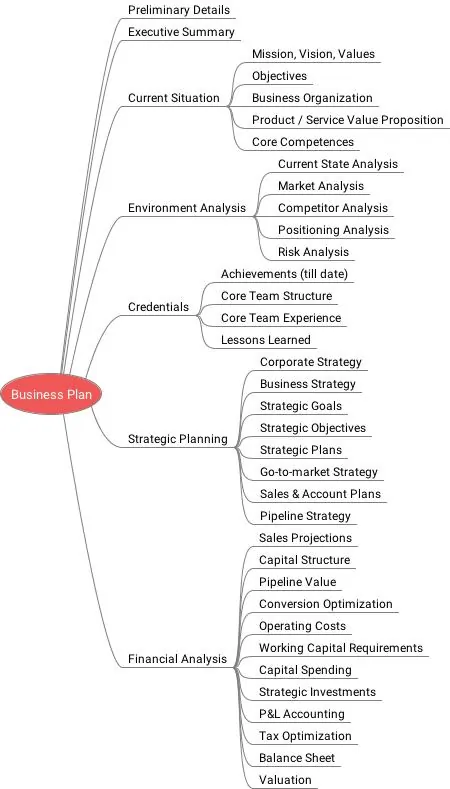
There are many excellent books focused on this topic , , . However, there are a couple of rules for writing a plan that actually gets read.
- Keep it short: Business plans should be short and concise. First, you want your collaterals to be read. Nobody would bother to read a 50 or 100 page document. An excessively long document is a hassle and will be shelved, never to be seen again.
- Know your audience: Write your business plan using a simple language. This ensures that your audience will understand your perspective. Keep explanations about your products or services simple and direct, Use terms that everyone understands. If required, use the appendix to provide more specific details.
Usually, you don’t have to start with a detailed plan that covers all functional areas. It is much easier to start with a simple, one-page document — what I call a Concept Paper — and then delve into details at a later stage.
Written by

Mithun Sridharan
Founder, LinkPress
Mithun is a strategist, advisor, educator, and speaker focused on helping leaders make better decisions in environments shaped by change, complexity, and emerging technology. His work brings together leadership, management consulting, digital transformation, and artificial intelligence in a way that is practical, grounded, and commercially relevant.
Related Posts
Evidence-based Practice (EBP)
Driving better outcomes by systematically applying the best available knowledge
Mithun Sridharan- Methodologies
- Concepts
- Frameworks
- Insights
- Sustainability
Amara's Law
We tend to overestimate the effect of a technology in the short run and underestimate the effect in the long run
Mithun Sridharan- Innovation
- Leadership
- Frameworks
- Concepts
RACI
RACI is a powerful tool used in project management and organizational planning to clarify roles and responsibilities
Mithun Sridharan- Concepts
- Frameworks
- Models
- Productivity