- Corporate Strategy
- Business Strategy
- Portfolio
Ashridge Portfolio Matrix
Evaluate business fit using parenting potential (Benefit) and understanding (Feel)
Corporate Parenting represents a key strategy adopted by highly centralized and diversified organizations that command significant resource reserves. This approach views the corporation as a repository of unique resources and core capabilities, which can be strategically deployed to boost the worth of individual business units and forge synergistic connections across the entire portfolio. Corporate strategy is generated by concentrating on the core competencies of the parent company and the value it adds through its relationship with its various businesses.
Essentially, there are three primary models of corporate parenting: financial control, strategic planning, and strategic control.
Styles Of Corporate Parenting
Financial Control
Under this model, the corporate parent’s core function is to carefully track and evaluate the financial performance of the overall investment portfolio, which is made up of the respective business units. Corporate managers effectively serve as agents for the shareholders and financial markets, tasked with identifying and acquiring viable assets and companies. Business unit executives are granted the autonomy necessary to execute daily business activities and make decisions at their local level. Nevertheless, the parent organization implements specific performance standards for control and monitoring purposes.
Strategic Planning
In this style, the corporate parent’s primary goal is to maximize synergistic benefits across all its business units. This objective can be achieved through various means, such as creating a unified corporate vision to build a common purpose, actively encouraging cooperation among different businesses, and offering essential central services and shared resources.
Strategic Control
The corporate parent in this arrangement utilizes its own specialized resources and competencies to increase the value of its subsidiary businesses. For instance, a corporation might possess a powerful, valuable brand or a highly specialized skill set. The corporate parent then employs these unique parenting capabilities to actively seek and capitalize on new opportunities for organizational growth.
Matrix”>The Ashridge Portfolio Matrix
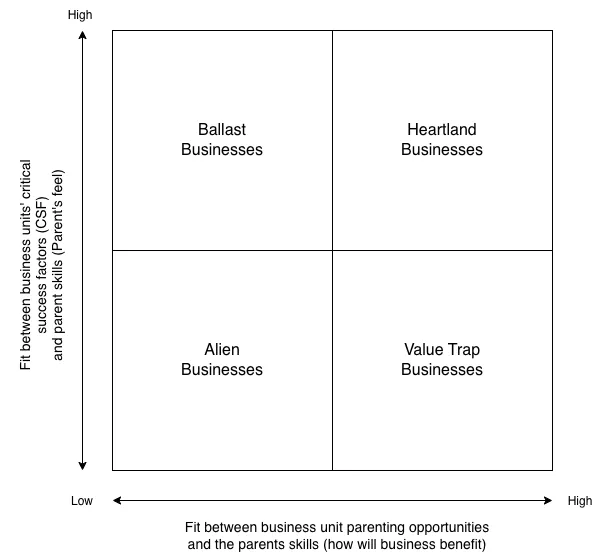
The Ashridge Portfolio Matrix is a vital tool used to assess how attractive a potential acquisition target or an existing business truly is to the parent corporation. This matrix evaluates the appeal of businesses based on two fundamental variables. One key variable is Benefit, and the other is Feel. In reality, however, other factors often influence the final decision regarding which potential acquisitions should be included in the business portfolio. These factors include past experiences, management styles and corporate culture, and the expectations of stakeholders. All pertinent factors must be weighed when making the final decision. Let’s explore each of these two main variables.
Benefits
This measures the potential value the parent company can deliver to the target business by applying its specific resources and capabilities. While the parent organization may have a multitude of resources and abilities, only those that the potential business specifically needs to achieve growth are relevant and contribute to the Benefit score. In essence, Benefits represent the clear opportunities the parent has to provide meaningful assistance. The more effectively the parent can assist, the greater the value it can generate.
Feel
Feel quantifies the inherent similarity between the corporate parent and the potential acquisition. Similarities are typically determined by alignment in industry, organizational structure, culture, and regulatory environment. Many other elements might also need consideration. Feel is crucially linked to the Critical Success Factors (CSF) associated with the elements mentioned above. If the parent company fully grasps what makes the potential business successful—because it understands its CSFs—it can then utilize its resources and capabilities with significantly greater effectiveness.
The interplay between high and low scores on Benefits and Feel determines the following four types of business acquisition targets, whose attractiveness varies based on the specific situation.
Mapping The Portfolio
The combination of high or low Benefit and high or low Feel creates four distinct quadrants on the Ashridge Matrix, each suggesting a very different strategic imperative for the corporate parent. By placing each business unit into one of these categories, the parent can determine the most appropriate treatment—or lack thereof—required for maximizing value.
Heartland Businesses (High Benefit, High Feel)
Heartland Businesses represent the ideal strategic fit for the corporate parent. They are situated squarely inside the parent’s industry, providing a high Feel—meaning the parent deeply understands the business and its Critical Success Factors. Furthermore, they are companies that lack the skills necessary for their success, presenting genuine opportunities for the parent to add significant value, hence the high Benefits score. These are the crown jewels of the portfolio. The parent can intervene, leveraging its resources and competencies, without the substantial risk of causing harm due to misunderstanding. Heartland Businesses should naturally form the very core of the future corporate strategy, receiving the highest level of strategic attention and investment.
Value Trap Businesses (High Benefit, Low Feel)
Value Trap Businesses are strategically perilous yet potentially rewarding. They typically operate outside the parent’s core industry, resulting in a dangerous low Feel—the parent lacks the inherent knowledge of the internal and external factors driving the business. However, they are classified as having high Benefits because the parent possesses resources and capabilities that the target acquisition critically lacks. This is where the risk-reward ratio is highest: the parent can add value, but its lack of intimate knowledge means it may do more harm than good through misguided interventions. The recommended treatment is highly cautious: only focus on these businesses if a clear and realistic path exists to move them into the Heartland category. This requires the corporate parent to be genuinely willing to learn the SBU’s business from the ground up, filling the knowledge gap to reduce the risk associated with a low Feel score.
Ballast Businesses (Low Benefit, High Feel)
Ballast Businesses are the comfortable, low-maintenance elements of the portfolio. They are situated inside the parent’s industry, resulting in a reassuring high Feel—the parent thoroughly understands the dynamics, culture, and CSFs of the business. However, their problem is an internal strength: these companies already possess the skills necessary for their success, meaning there are no opportunities for the parent to add value; they score low on Benefits. While the businesses are stable and well-understood, they contribute little to the parent’s overall value-creation mission. The strategic treatment for Ballast Businesses is a light touch from the parent. They require minimal oversight and intervention, as the corporate center has little to offer in terms of resource leverage or specialized assistance. The focus should be on efficient financial control without disrupting their internal stability.
Alien Businesses (Low Benefit, Low Feel)
Alien Businesses represent the worst strategic fit and are typically the easiest decision on the matrix. They operate outside the parent’s industry, leading to a crippling low Feel—the parent has little to no knowledge of the factors required to make the business successful. To compound the problem, these businesses also possess the skills necessary for their success, meaning there is little to no opportunity for the parent to add value; they score low on Benefits. The combination of poor fit and minimal potential for value-add results in a high chance of corporate failure. For these businesses, the parent has a fundamentally poor fit and can do little to help anyway. The strategic treatment is unambiguous: dispose of them. Continuing to hold Alien Businesses consumes valuable management attention and resources that could be better deployed in the Heartland.
| Category | Description | Treatment |
|---|---|---|
| Heartlands | The parent can increase value without risking damage to the Strategic Business Unit (SBU) | These should form the essential core of the future corporate strategy |
| Ballasts | The parent understands the SBU well but has limited ability to add specific value | They require a hands-off approach from the parent company |
| Value Traps | The parent could potentially add value but runs a high risk of causing more damage than good | They should only be pursued if they can realistically be transitioned into the Heartland category. For this to happen, the parent must commit to learning the SBU’s business model thoroughly |
| Aliens | The parent is a poor fit with the SBU and can offer minimal assistance regardless | These businesses must be divested |
Written by

Mithun Sridharan
Founder, LinkPress
Mithun is a strategist, advisor, educator, and speaker focused on helping leaders make better decisions in environments shaped by change, complexity, and emerging technology. His work brings together leadership, management consulting, digital transformation, and artificial intelligence in a way that is practical, grounded, and commercially relevant.
Related Posts
Consultants Just Tell You What You Already Know
Converting Hidden Knowledge Into Actionable Strategic Clarity
Mithun Sridharan- Strategic Management
- Business Strategy
- Decision-Making
- Corporate Strategy
- Insights
- Context
Stakeholder vs Shareholder
Precision in defining primary beneficiaries determines the allocation of capital and strategic priority
Mithun Sridharan- Governance
- Corporate Strategy
- Business Strategy
- Fiduciary Duty
- ESG Integration
- Value Creation
MOST Model
Connecting Corporate Vision to Daily Operational Execution
Mithun Sridharan- Governance
- Corporate Strategy
- Business Strategy